Well after this weekend, my bracket is officially busted. Blast... Heartbreaking that both state teams went down the same day. Can't dwell on it too much or it'll ruin my day! In other news, a quick note that I bought my plane ticket home yesterday. So it's official, June 13th I'll be back in the Mitten! Woot woot! Now onto regularly scheduled programming.
Santi Quattro Coronati
Today we had a bit of a surprise at the church of the Four Crowned Saints. Italy lags a bit behind the States, so we just 'sprung forward' last weekend. Nice that we have some extended daylight in the evenings now, but we're back to walking in the dark to our daily station church. I think today's church may have been our farthest walk yet; Four Saints is located just a bit beyond the basilica of San Clemente, which is already way out past the Colosseum.
So when we arrived at this old church, we discovered there was a power outage in that neighborhood of the city because no lights were on. Since it was still before sunrise, the church was lit up with candles instead. I believe the hip description for that would be, "rustic and vintage". Actually it was really cool, it's a very different atmosphere in the candlelight.
Digital cameras have a really hard time taking low light pictures. That top one is about how dark it was when I walked in, but the window light in the sanctuary is overexposed in the picture, so imagine a more subdued twilight coming through instead. I sat down in the back and took a long shutter shot of the sanctuary, so the second pic much brighter than real life, but you can get an idea of the space.
The story of this church's title actually comes from two groups of folks. Both groups were martyrs during the Roman persecutions (like practically every other church we've seen!). The first group were four soldiers, Severus Victorinus, Carpophorus, and Severinus, who refused to take part in pagan worship and were killed for this in the persecutions of the Emperor Diocletian. The second group was made up of five stonemasons, Claudius, Nicostratus, Sempronianus, Castor, and Simplicius, who were put to death for their refusal to carve a statue of the god Asclepius which would be used for pagan worship.
The oldest parts of the current building come from the fourth century. Around the 630 Pope Honorius I dedicated the first church on this site, which was restored by Pope Hadrian I in the late eighth century. A century later Pope Leo IV undertook a more complete rebuilding and placed the relics of many martyrs in a crypt beneath the main altar, including those of the four soldiers and the five stonemasons.
Along with many other building in the area, this church sustained heavy damage during the Norman invasion of 1084, so Pope Paschal II rebuilt the church, retaining the previous apse but making the new nave markedly smaller; he consecrated it in 1116. In 1560 Augustinian nuns took up residence here, where they have remained up to the present day. The apse fresco comes from the 1620s, which was the last major renovation / redecoration of this church. Beneath the apse fresco are additional frescoes that depict the suffering, death, and burial of the soldiers and stonemasons. One other random fact: the skull of St. Sebastian is found in a small niche above the altar on the left side of the sanctuary (the one you always see depicted in art tied to a pole with arrows shot into his body).
You walk through two courtyards to get to this church. The inner courtyard used to be part of the nave before it was rebuilt. Walking out was a nice view of the sunlight coming through the entrance, and a nice shot of the cloister facade that is attached to this church.
Monday, March 31, 2014
Friday, March 28, 2014
Friday of Third Week: San Lorenzo in Lucina
We've made it to another Friday. Feels good! Let's get right to it:
San Lorenzo in Lucina
This is the third station church yet which is dedicated to our friend Saint Lawrence the deacon. Lucina and Panisperna (Thursday, first week) we've seen, and last Sunday's station church was the basilica of Saint Lawrence outside the Walls. Next week we'll go to a fourth church named after him. This dude was popular back in his day!
The name Lucina comes from the Roman landowner and donor of the property for this church. Lucina lived in her large apartment on this spot during the early Imperial period, which at the time was located nearby the famous Ara Pacis.
The Ara Pacis Augustae was a monument commissioned by the Roman senate in 13 BC to honor the return of Augustus to Rome after three years of conquest in Hispaniola and Gaul. Four years later in 9 BC it was consecrated by the Roman senate to celebrate the peace that Augustus brought to the Roman Empire with his military victories. It stood, however, in the flood plain of the Tiber river (though originally it was guarded from this by a wall), and over the centuries the Ara was buried under about 15 feet of silt. It was rediscovered in the 20th century and relocated a few blocks north, still in pristine condition; it has its own museum now where you can go and see it.
But back to St. Lawrence. The first basilica on this site was built by Pope Sixtus III in the mid 430s. That church stood until 1084 when it, too, (like San Clemente which we saw Monday last week) suffered fire damage from the Norman invasion of the city. The restored church was dedicated by Pope Anacletus II in 1130. The nave was originally flanked on either side by aisles, but during the 17th century these were both converted into four side chapels a piece which opened to the nave. Blessed Pope Pius IX did some more renovating in the mid 19th century to bring the church to the look that we have today.
This last photo is of the altar in the first side chapel on the right, when you enter this church. Inside that box is part of the gridiron on which St. Lawrence was grilled. St. Lawrence, pray for us!
San Lorenzo in Lucina
This is the third station church yet which is dedicated to our friend Saint Lawrence the deacon. Lucina and Panisperna (Thursday, first week) we've seen, and last Sunday's station church was the basilica of Saint Lawrence outside the Walls. Next week we'll go to a fourth church named after him. This dude was popular back in his day!
The name Lucina comes from the Roman landowner and donor of the property for this church. Lucina lived in her large apartment on this spot during the early Imperial period, which at the time was located nearby the famous Ara Pacis.
The Ara Pacis Augustae was a monument commissioned by the Roman senate in 13 BC to honor the return of Augustus to Rome after three years of conquest in Hispaniola and Gaul. Four years later in 9 BC it was consecrated by the Roman senate to celebrate the peace that Augustus brought to the Roman Empire with his military victories. It stood, however, in the flood plain of the Tiber river (though originally it was guarded from this by a wall), and over the centuries the Ara was buried under about 15 feet of silt. It was rediscovered in the 20th century and relocated a few blocks north, still in pristine condition; it has its own museum now where you can go and see it.
But back to St. Lawrence. The first basilica on this site was built by Pope Sixtus III in the mid 430s. That church stood until 1084 when it, too, (like San Clemente which we saw Monday last week) suffered fire damage from the Norman invasion of the city. The restored church was dedicated by Pope Anacletus II in 1130. The nave was originally flanked on either side by aisles, but during the 17th century these were both converted into four side chapels a piece which opened to the nave. Blessed Pope Pius IX did some more renovating in the mid 19th century to bring the church to the look that we have today.
This last photo is of the altar in the first side chapel on the right, when you enter this church. Inside that box is part of the gridiron on which St. Lawrence was grilled. St. Lawrence, pray for us!
Thursday, March 27, 2014
Thursday of Third Week: Santi Cosma e Damiano
Today was a drizzly morning for the station church walk. I guess we could consider it a 'rainy' day b/c I needed my umbrella, which means the official rain-free streak has been put asunder. But I suppose the same thing happened as well on Monday morning with St. Mark's...kinda. So maybe that streak was snapped on Monday. At any rate, having only two semi-rainy mornings thus far is much better than it could be! So I'll take it.
Santi Cosma e Damiano
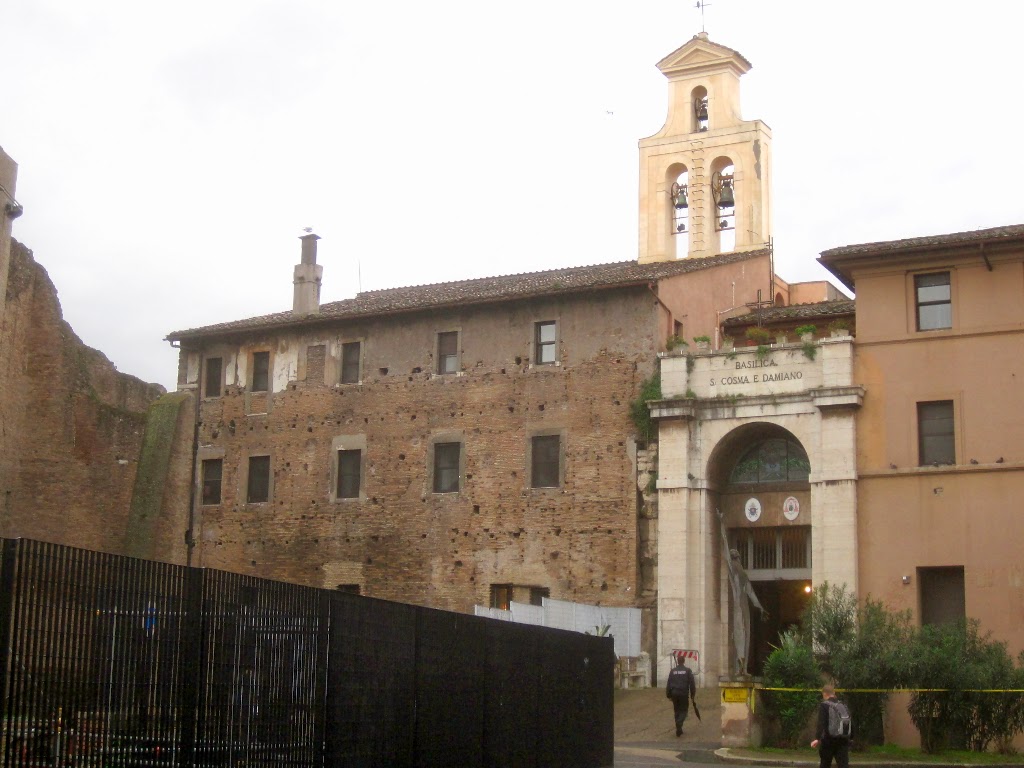
The basilica of Saints Cosmas and Damian sits on the site of the ancient Roman Forum, a few hundred yards down from the Colosseum. Its patrons were two brothers who lived during the late third century in Syria. As medical professionals they used their skills to heal people without seeking payment for their work. The two were martyred around 303 AD during the Diocletian persecutions in the city of Aegea, then a part of Roman Syria. They were convicted for their faith before a tribunal and were tortured before being decapitated. Their relics were later brought to the city of Cyr before being transferred to Rome during the time of Pope St. Gregory the Great (+604).
Some of the foundation walls where this basilica is built date as far back as Emperor Vespasian (ruled 69 - 79). Pope Felix IV (+530) modified the Roman building there to convert it into a Christian place of worship. The apse mosaics which we see today come from that time as well (nifty!).
I was really surprised when I walked in. This church is really short and squat. The last picture is taken almost from the very back. There is room enough for about 60-70 people in the pews, so half of us lined the rear and side chapels. The art in here is beautiful though, especially the apse mosaic (6th century) and the high altar (17th century) with a Madonna and Child icon from the 13th century.
In the mosaic, Christ in the middle stands on the River Jordan and is flanked by Ss. Peter and Paul who are presenting Cosmas and Damian to the Lord. The two brothers each hold a crown, symbols of their victory for Christ, while the palm trees in the image are symbols of martyrdom. Pope Felix is all the way on the left, holding in his hand the church he established
Santi Cosma e Damiano
The basilica of Saints Cosmas and Damian sits on the site of the ancient Roman Forum, a few hundred yards down from the Colosseum. Its patrons were two brothers who lived during the late third century in Syria. As medical professionals they used their skills to heal people without seeking payment for their work. The two were martyred around 303 AD during the Diocletian persecutions in the city of Aegea, then a part of Roman Syria. They were convicted for their faith before a tribunal and were tortured before being decapitated. Their relics were later brought to the city of Cyr before being transferred to Rome during the time of Pope St. Gregory the Great (+604).
Some of the foundation walls where this basilica is built date as far back as Emperor Vespasian (ruled 69 - 79). Pope Felix IV (+530) modified the Roman building there to convert it into a Christian place of worship. The apse mosaics which we see today come from that time as well (nifty!).
| This is the side entrance to the church, so it doesn't look like much of a church from this angle. |
| We walked through a small courtyard of an attached Franciscan cloister before entering the basilica. |
I was really surprised when I walked in. This church is really short and squat. The last picture is taken almost from the very back. There is room enough for about 60-70 people in the pews, so half of us lined the rear and side chapels. The art in here is beautiful though, especially the apse mosaic (6th century) and the high altar (17th century) with a Madonna and Child icon from the 13th century.
In the mosaic, Christ in the middle stands on the River Jordan and is flanked by Ss. Peter and Paul who are presenting Cosmas and Damian to the Lord. The two brothers each hold a crown, symbols of their victory for Christ, while the palm trees in the image are symbols of martyrdom. Pope Felix is all the way on the left, holding in his hand the church he established
Wednesday, March 26, 2014
Wednesday of Third Week: Sant' Andrea della Valle
Today we're taking a detour. The originally listed station church, San Sisto, was not available to us due to renovations. So we went off to Sant Andrea della Valle instead. I love this church! It's so beautiful. Plus its patron is St. Andrew, who is my Confirmation saint.
Sant' Andrea della Valle
I don't have much on this church since it is not part of our Procedamus station church booklet, but I can fill in a few details (thank you Google). This church is super new in the scheme of things. Its construction only began in the year 1590 and it was completed 60 years later. The Baroque facade which you see today was added a few years after its dedication, between 1655 and 1663. The duchess of Amalfi, Donna Costanza Piccolomini d'Aragona, bequeathed her palace and the adjacent church of San Sebastiano on this site to the religious order of the Theatines for the construction of a new church. Amalfi's patron saint is St. Andrew, and so this church was planned in his honor.
The Theatines are also known as the Congregation of Clerks Regular of the Divine Providence. They were founded by St. Cajetan and his companions on May 3, 1524, and were approved by Pope Clement VII only a few months later on June 24. Their order sought to reform the life of both clergy and lay faithful with a call to greater conversion and the practice of virtue. The order quickly became quite successful, and this church was one of the early fruits of its labors.
There are tons of beautiful things to see in this church, definitely one to put on the list. But the ambiance is quite unique compared to other Baroque churches because all the windows along the vaulted ceiling and in the apse are stained a light yellow. So when you walk in on a sunny day you see the whole place flooded with yellow light -- the effect is worth a good look.
Sant' Andrea della Valle
I don't have much on this church since it is not part of our Procedamus station church booklet, but I can fill in a few details (thank you Google). This church is super new in the scheme of things. Its construction only began in the year 1590 and it was completed 60 years later. The Baroque facade which you see today was added a few years after its dedication, between 1655 and 1663. The duchess of Amalfi, Donna Costanza Piccolomini d'Aragona, bequeathed her palace and the adjacent church of San Sebastiano on this site to the religious order of the Theatines for the construction of a new church. Amalfi's patron saint is St. Andrew, and so this church was planned in his honor.
The Theatines are also known as the Congregation of Clerks Regular of the Divine Providence. They were founded by St. Cajetan and his companions on May 3, 1524, and were approved by Pope Clement VII only a few months later on June 24. Their order sought to reform the life of both clergy and lay faithful with a call to greater conversion and the practice of virtue. The order quickly became quite successful, and this church was one of the early fruits of its labors.
There are tons of beautiful things to see in this church, definitely one to put on the list. But the ambiance is quite unique compared to other Baroque churches because all the windows along the vaulted ceiling and in the apse are stained a light yellow. So when you walk in on a sunny day you see the whole place flooded with yellow light -- the effect is worth a good look.
Tuesday, March 25, 2014
Tuesday of Third Week: Santa Pudenziana
Happy Solemnity of the Annunciation! This feast is fun because it's also a bit clever. If Jesus is born for us every December 25, what happens 9 months before that day? Yup, today on March 25th Mary says 'yes' to God and so the Holy Spirit brings a bun for the oven. The official 'Incarnation Day' of God is worth celebrating as a Church! The feast is called the Annunciation because God's plan of salvation came to us through the announcement of the archangel Gabriel to Mary. See, it all makes so much sense.
I'll try to keep today's post short and sweet; these things can start to snowball if you're not careful. Our Tuesday station church takes us almost all the way out to Santa Maria Maggiore again. A fair bit of walking. But thankfully the weather was cooperative -- it didn't start raining until about 10am.
Santa Pudenziana
The namesake of this church begins with a Roman senator named Pudens (possibly the same Pudens mentioned by Paul in 2 Tm 4:21). What interesting names they all had back then. Pudens had two daughters, Pudentiana and Praxedes. His daughters (like St. Cecilia's husband St. Valerian and his brother St. Tiberius) collected the remains of the Christian martyrs and laid them to rest in a well within their home, which sat on the spot of this church. By the end of the 4th century there was a bath hall standing over the remains of their house which was renovated and expanded to become instead a church for Christian worship.
That church included the current rear apse which you see can below. And in that apse is a mosaic which hails all the way back from the time of the church's initial expansion and renovation. Whoa! This makes it one of the only mosaics from the late 4th / early 5th century that has survived to the present day. The difference with the latter mosaics found in other churches in the city is striking: instead of the gilded and stylized Byzantine appearance from churches a few centuries after this one (like the apse mosaics of A LOT of the churches we have seen), here we have a mosaic expressing a truly Roman style of art with figures all dressed in the style of ancient Rome.
The beautiful and important part about this church is that the house on which it stands, Senator Pudens' house, was also the welcoming and living place of St. Peter for at least six years while Peter guided the Church in Rome. It is therefore generally believed that this spot is the first place Peter ever celebrated the Mass in Rome.
I'll try to keep today's post short and sweet; these things can start to snowball if you're not careful. Our Tuesday station church takes us almost all the way out to Santa Maria Maggiore again. A fair bit of walking. But thankfully the weather was cooperative -- it didn't start raining until about 10am.
Santa Pudenziana
The namesake of this church begins with a Roman senator named Pudens (possibly the same Pudens mentioned by Paul in 2 Tm 4:21). What interesting names they all had back then. Pudens had two daughters, Pudentiana and Praxedes. His daughters (like St. Cecilia's husband St. Valerian and his brother St. Tiberius) collected the remains of the Christian martyrs and laid them to rest in a well within their home, which sat on the spot of this church. By the end of the 4th century there was a bath hall standing over the remains of their house which was renovated and expanded to become instead a church for Christian worship.
That church included the current rear apse which you see can below. And in that apse is a mosaic which hails all the way back from the time of the church's initial expansion and renovation. Whoa! This makes it one of the only mosaics from the late 4th / early 5th century that has survived to the present day. The difference with the latter mosaics found in other churches in the city is striking: instead of the gilded and stylized Byzantine appearance from churches a few centuries after this one (like the apse mosaics of A LOT of the churches we have seen), here we have a mosaic expressing a truly Roman style of art with figures all dressed in the style of ancient Rome.
The beautiful and important part about this church is that the house on which it stands, Senator Pudens' house, was also the welcoming and living place of St. Peter for at least six years while Peter guided the Church in Rome. It is therefore generally believed that this spot is the first place Peter ever celebrated the Mass in Rome.
Monday, March 24, 2014
Monday of Third Week: San Marco
And here we go, week three. The faithful remainder of Roman station church seminarians continues to slowly dwindle. Lol. Keep praying for me! I have not missed one yet. Although between the priests, seminarians, and college kids abroad / professionals abroad that are doing this with us, I'd say we are still holding strong at about 150 a day. The Lenten station churches have been a great teacher about Christian spirituality and human growth. This is the part where I'm going to use this post to preach to myself because it's late and I'm tired. The basic idea I have found to be true is this: that when seeking to grow closer to God (as we do especially in this Lenten season), the human spirit is not so much deterred by the idea that sacrifice will be necessary, but it is always confronted by the measure of its willingness to suffer.
Uhhh. What? So now let me give you my concrete example; it shall all become clear. During Lent, one may decide to chase after the Lord with greater fervor by attending weekday station church Masses in the city of Rome. In fact, the human spirit is so enamored with hope and so encouraged to 'run the race' and 'win the imperishable crown', that the foreknowledge of necessary sacrifices (like consistently losing sleep and walking an extra few miles every day) do not hinder or dampen its fervor. In fact, one even finds excitement at the thought of doing battle for the Lord and meeting these sacrifices with God's grace.
So then what happens? Well, one is inevitably confronted by the reality of those sacrifices, which slowly but surely attempt to overwhelm the spirit and cause it to turn back from its goal. The plot thickens... It's harder to wake up. The body is sore. The legs are tired. The mind is tired. All the 'fun' is gone. It is at this point that we meet an important spiritual juncture. One sees the true measure of one's own willingness to suffer for the goal it has set before itself, and the drama of nature vs. grace, of conversion and salvation -- that drama unfolds, that battle is waged every morning in the heroic minute when the alarm goes off... again.
Amazing, salvation is won and lost in the simple and oh-so-ordinary moments when one decides, for example, whether to put his feet on the ground, or simply snooze the alarm and roll over. Lol, now is this all just a pinch melodramatic? Probably. But kinda not. The plain-Jane point is that, as with most things in life, there are talkers, and there are walkers, and there is a world of difference between the two. We gotta be walkers. We gotta be. The apostle James calls it being a 'doer of the word'.
And the game changer of it all, the difference between talking and walking, that's love (or as Frankie Sinatra says it, that's amore). Why? Because love is the only force in the entire universe that has the power to transform suffering into something meaningful.
When we love something we are willing to suffer for it, and in fact, in the context of love, a mountain of suffering looks to us like a bump in the road. So when mom gets up at 2am every morning for months to feed and calm baby, that's no small suffering for mom. But mom loves baby so deeply that the suffering of lost sleep and a weary body is nothing in comparison to the joy of holding flesh of her flesh and bone of her bone. So what am I saying, really. Brian, only that it's time you keep on running that race. I love God, and you wanna know what, these station churches have been awesome.
Man oh man I am sorry you haven't heard anything about Saint Mark's today; it was quite nice, the columns in the nave were just beautiful, made from Sicilian jasper. I hope this bit of rambling will hold you over until tomorrow. I'll at least leave you with the pics, which were disappointing because the lighting was so low that I couldn't get a great shot. So actually I'll give you one that another guy took with a better camera. Yeah that works. Enjoy! Oh yeah, and happy vigil of the Solemnity of the Annunciation!
Uhhh. What? So now let me give you my concrete example; it shall all become clear. During Lent, one may decide to chase after the Lord with greater fervor by attending weekday station church Masses in the city of Rome. In fact, the human spirit is so enamored with hope and so encouraged to 'run the race' and 'win the imperishable crown', that the foreknowledge of necessary sacrifices (like consistently losing sleep and walking an extra few miles every day) do not hinder or dampen its fervor. In fact, one even finds excitement at the thought of doing battle for the Lord and meeting these sacrifices with God's grace.
So then what happens? Well, one is inevitably confronted by the reality of those sacrifices, which slowly but surely attempt to overwhelm the spirit and cause it to turn back from its goal. The plot thickens... It's harder to wake up. The body is sore. The legs are tired. The mind is tired. All the 'fun' is gone. It is at this point that we meet an important spiritual juncture. One sees the true measure of one's own willingness to suffer for the goal it has set before itself, and the drama of nature vs. grace, of conversion and salvation -- that drama unfolds, that battle is waged every morning in the heroic minute when the alarm goes off... again.
Amazing, salvation is won and lost in the simple and oh-so-ordinary moments when one decides, for example, whether to put his feet on the ground, or simply snooze the alarm and roll over. Lol, now is this all just a pinch melodramatic? Probably. But kinda not. The plain-Jane point is that, as with most things in life, there are talkers, and there are walkers, and there is a world of difference between the two. We gotta be walkers. We gotta be. The apostle James calls it being a 'doer of the word'.
And the game changer of it all, the difference between talking and walking, that's love (or as Frankie Sinatra says it, that's amore). Why? Because love is the only force in the entire universe that has the power to transform suffering into something meaningful.
When we love something we are willing to suffer for it, and in fact, in the context of love, a mountain of suffering looks to us like a bump in the road. So when mom gets up at 2am every morning for months to feed and calm baby, that's no small suffering for mom. But mom loves baby so deeply that the suffering of lost sleep and a weary body is nothing in comparison to the joy of holding flesh of her flesh and bone of her bone. So what am I saying, really. Brian, only that it's time you keep on running that race. I love God, and you wanna know what, these station churches have been awesome.
Man oh man I am sorry you haven't heard anything about Saint Mark's today; it was quite nice, the columns in the nave were just beautiful, made from Sicilian jasper. I hope this bit of rambling will hold you over until tomorrow. I'll at least leave you with the pics, which were disappointing because the lighting was so low that I couldn't get a great shot. So actually I'll give you one that another guy took with a better camera. Yeah that works. Enjoy! Oh yeah, and happy vigil of the Solemnity of the Annunciation!
Friday, March 21, 2014
Friday of Second Week: San Vitale
Hey, we made it! Happy Friday everyone. How is your NCAA bracket holding up? Alas, I will not be winning $1 billion of Warren Buffet's wealth. But let's be real, it's a safe bet to make when the odds of actually shelling out that kind of money are more than 1 in 9 quintillion. So if every single person on the earth filled out approximately 1,300,000,000 unique brackets, and no bracket in the whole world was a duplicate, then ONE bracket of the entire lot would win a billion bucks. Oh well, it was a good run. The great thing about sports is, "there's always next year!".
So let's talk about today's station church. We leave Trastevere to go back in the direction of my theology school, the Greg; except walk past it for about another half mile and you get to San Vitale. Like yesterday at Santa Maria, this church has an interesting connection to our elder brother England.
San Vitale
We go back in time to 1535 and make our way to one of the dungeon chambers of the Tower of London. Inside is John Fisher, the Catholic bishop of the diocese of Rochester, who is imprisoned there for his refusal to accept King Henry VIII's First Succession Act (and shortly before his death, also the Act of Supremacy).
Henry wanted to annul his marriage to Queen Catherine of Aragon b/c she was not producing a male heir for the Tudor dynasty; he also had his eyes set on Anne Boleyn, a young woman in the queen's entourage. The king appealed to Pope Clement VII for a declaration of nullity, which was never granted... and so what does one do when one wants one's own way? One makes oneself one's own moral authority.
A couple things happen in succession...Henry leaves Catherine, deceptively convinces the pope to approve his buddy Thomas Cranmer as Archbishop of Canterbury, then secretly marries Anne. She becomes pregnant, so he publicly marries her, then sets up a special court wherein Cranmer declares his marriage to Catherine invalid and afterward declares his marriage to Anne valid. John Fisher openly opposes the king's divorce, which upsets Henry and begins John's troubles.
The king proceeded to pass the First Succession Act in March 1534, by which the king could compel any person to take an oath of succession, acknowledging the progeny of Henry and Anne as legitimate heirs to the throne. John Fisher refused the oath and was imprisoned in April 1534. Later in November, Henry put the Act of Supremacy through the English parliament, which declared him to be "the only supreme head on earth of the Church of England"; those who denied this, by the way, would be considered guilty of treason. Fisher rejected the king's supremacy in early May 1535 from his prison cell in the Tower of London, affirming his allegiance to the pope and the supremacy of the See of St Peter. For this he would be quickly tried and convicted of treason.
And this is what finally brings us to our station church! Also in May of 1535 the newly elected Pope Paul III, in an effort to save John, elevated him to the honor of cardinal and assigned to him the church of San Vitale as his titular church in Rome. Upon hearing this, King Henry declared that, rather than send the red hat to England (as cardinals wear red), he would send the bishop's head to the pope! And this Henry did. Well, he didn't mail John's head, but he had the bishop beheaded on the 22nd of June and hung his head from the London Bridge for two weeks (at which time it was thrown into the Thames and replaced with Sir Thomas More's head).
Well all that wasn't really saying too much about our station church, but it is interesting nonetheless!
St. Vitalis is the patron of this church, a(nother) martyr during the Roman persecutions of the early 2nd century. Two large paintings which hang on the left and right walls just before the sanctuary depict his martyrdom: he was tortured on the rack before being buried alive. His wife and sons were also martyrs, Ss. Valeria, Gervasius and Protasius. A small oratory was built on this site in the late 4th century dedicated to Vitalis' sons. Later in the 5th century Pope Innocent I built a larger church here with the help of a wealthy widow named Vestina, who upon her death left all her money for this purpose. By the seventh century it began being referred to as St. Vitalis and was the last-built church to be included on the original list of titular churches of Rome.
Let's take a gander at a few photos of San Vitale to finish 'er up:
So let's talk about today's station church. We leave Trastevere to go back in the direction of my theology school, the Greg; except walk past it for about another half mile and you get to San Vitale. Like yesterday at Santa Maria, this church has an interesting connection to our elder brother England.
San Vitale
We go back in time to 1535 and make our way to one of the dungeon chambers of the Tower of London. Inside is John Fisher, the Catholic bishop of the diocese of Rochester, who is imprisoned there for his refusal to accept King Henry VIII's First Succession Act (and shortly before his death, also the Act of Supremacy).
Henry wanted to annul his marriage to Queen Catherine of Aragon b/c she was not producing a male heir for the Tudor dynasty; he also had his eyes set on Anne Boleyn, a young woman in the queen's entourage. The king appealed to Pope Clement VII for a declaration of nullity, which was never granted... and so what does one do when one wants one's own way? One makes oneself one's own moral authority.
A couple things happen in succession...Henry leaves Catherine, deceptively convinces the pope to approve his buddy Thomas Cranmer as Archbishop of Canterbury, then secretly marries Anne. She becomes pregnant, so he publicly marries her, then sets up a special court wherein Cranmer declares his marriage to Catherine invalid and afterward declares his marriage to Anne valid. John Fisher openly opposes the king's divorce, which upsets Henry and begins John's troubles.
The king proceeded to pass the First Succession Act in March 1534, by which the king could compel any person to take an oath of succession, acknowledging the progeny of Henry and Anne as legitimate heirs to the throne. John Fisher refused the oath and was imprisoned in April 1534. Later in November, Henry put the Act of Supremacy through the English parliament, which declared him to be "the only supreme head on earth of the Church of England"; those who denied this, by the way, would be considered guilty of treason. Fisher rejected the king's supremacy in early May 1535 from his prison cell in the Tower of London, affirming his allegiance to the pope and the supremacy of the See of St Peter. For this he would be quickly tried and convicted of treason.
And this is what finally brings us to our station church! Also in May of 1535 the newly elected Pope Paul III, in an effort to save John, elevated him to the honor of cardinal and assigned to him the church of San Vitale as his titular church in Rome. Upon hearing this, King Henry declared that, rather than send the red hat to England (as cardinals wear red), he would send the bishop's head to the pope! And this Henry did. Well, he didn't mail John's head, but he had the bishop beheaded on the 22nd of June and hung his head from the London Bridge for two weeks (at which time it was thrown into the Thames and replaced with Sir Thomas More's head).
Well all that wasn't really saying too much about our station church, but it is interesting nonetheless!
St. Vitalis is the patron of this church, a(nother) martyr during the Roman persecutions of the early 2nd century. Two large paintings which hang on the left and right walls just before the sanctuary depict his martyrdom: he was tortured on the rack before being buried alive. His wife and sons were also martyrs, Ss. Valeria, Gervasius and Protasius. A small oratory was built on this site in the late 4th century dedicated to Vitalis' sons. Later in the 5th century Pope Innocent I built a larger church here with the help of a wealthy widow named Vestina, who upon her death left all her money for this purpose. By the seventh century it began being referred to as St. Vitalis and was the last-built church to be included on the original list of titular churches of Rome.
Let's take a gander at a few photos of San Vitale to finish 'er up:
Subscribe to:
Posts (Atom)