Thursday, March 20, 2014

Thursday of Second Week: Santa Maria in Trastevere

We're almost there!  Anybody with me?  Thursday is my long day, besides these three hours of oasis in the middle of the day, I am fully 'occupato' with something straight through from 6am - 10pm.  Sometimes the best we can do is hold on for dear life and say, Come on Friday!!  Lol.  But it's good; better to be busy than to be bored... and it makes Fridays extra nice.

Santa Maria in Trastevere

We're sticking it out in the Trastevere neighborhood again today.  Not quite as far a walk as St. Cecilia, this church named after our Virgin Mother stands on the site of a spring of oil which came forth from the ground in 38 BC.  It was linked to the coming of the Savior into the world and in the early third century became the site of a house church established by Pope Callixtus I (while Christianity was still illegal).  The pope himself would be cast into a nearby well in 223 for professing the Christian faith.

After the legalization of the faith, Pope Julius I (+352) built a basilica here to replace the house church.  This basilica was nearly destroyed by fire in the sack of Rome in 410 by the Visigoths (an event which, on an unrelated note, became an inspiration for St. Augustine to write one of his most famous works, City of God ).  Eight centuries later Pope Innocent II decided to demolish it and build a new church, so the new construction proceeded from 1139 until 1181, when it was finished and rededicated.


The statues you see above the outer porch (which was built in 1702) depict Ss. Callixtus, Cornelius, Julius I, and Calepodius, all of whose relics rest beneath the high altar.  Pope Innocent II is also buried here half way up along the left aisle.  You can find by looking at the columns in the nave that they have all been recycled from the ruined buildings of ancient Rome (as has been the customary practice around here for ages!  Just look at the Colosseum).

The mosaic in the apse, from the twelfth century, depicts Christ and the Virgin Mary flanked by Ss. Peter and Paul, all the saints mentioned above, plus St. Lawrence the Deacon, who we saw the other day, the one burned alive on a gridiron.  Another Catholic Englishman, Henry Cardinal Stuart, sponsored the adornment of one of the side chapels up near the sanctuary in the mid 18th century, and so you will find his coat of arms above the door to the chapel.  He was the duke of York and the last Catholic claimant to the English throne.

Wednesday, March 19, 2014

Wednesday of Second Week: Santa Cecilia in Trastevere

Happy Solemnity of St. Joseph!  One of the great days during the Lenten season, when we get to feast instead of fast.  Woohoo!  Thank you St. Joseph..  In Italy they have their own sweet doughnut-y recipe that comes out today.  They're called zeppole di San Giuseppe, doughnut-sized deep-fried dough balls topped with powdered sugar and a custard-type cream on the inside.  Basically, the Italian version of the paczki which we eat on Fat Tuesday.  Delicious.  Although on a side note, I have found out since coming to Rome that eating paczki on Fat Tuesday is apparently a Michigan thing.  Nobody outside of our state knows about these things!  That's too bad.  More sweets for us!

Santa Cecilia in Trastevere

Today's station church is found in the Trastevere neighborhood of Rome.  It is west of the Tiber and a bit south of St. Peter's.  Luckily for us, that means it's much closer to the NAC, so this morning I enjoyed 15 more minutes of sleep.

St. Cecilia is a wonderful wonderful saint.  She is the patroness of musicians, and in Christian art is very often pictured with a musical instrument (typically an organ or viola).  Although I would like to know more about that, since she was alive way before organs and violas existed.

Cecilia was a Roman maiden of the early third century engaged to be married to a pagan named Valerian.  After their marriage, she brought him to Pope Urban I and following this meeting, Valerian had a vision which led him to convert.  The conversion of his brother Tiberius would soon follow, and subsequently the two began burying the remains of the Christian martyrs.  This of course attracted the suspicion of Roman authorities, who demanded that they sacrifice to a statue of Jupiter.  They refused and so were beheaded.  Cecilia was next arrested and condemned to suffocation in the bath of her house.  Miraculously the suffocation did not harm her, so the Romans decided to cut off her head, too.

Alas, after three strikes of the ax she was wounded but not killed.  Roman law forbade more than three strikes, so she was left there to die of her wounds.  Cecilia persisted for three days but in that time was visited by Urban.  She gave over her possessions to the Church and asked that her home be turned into a place of worship of God.  This brings us to the spot upon which today's church is built.
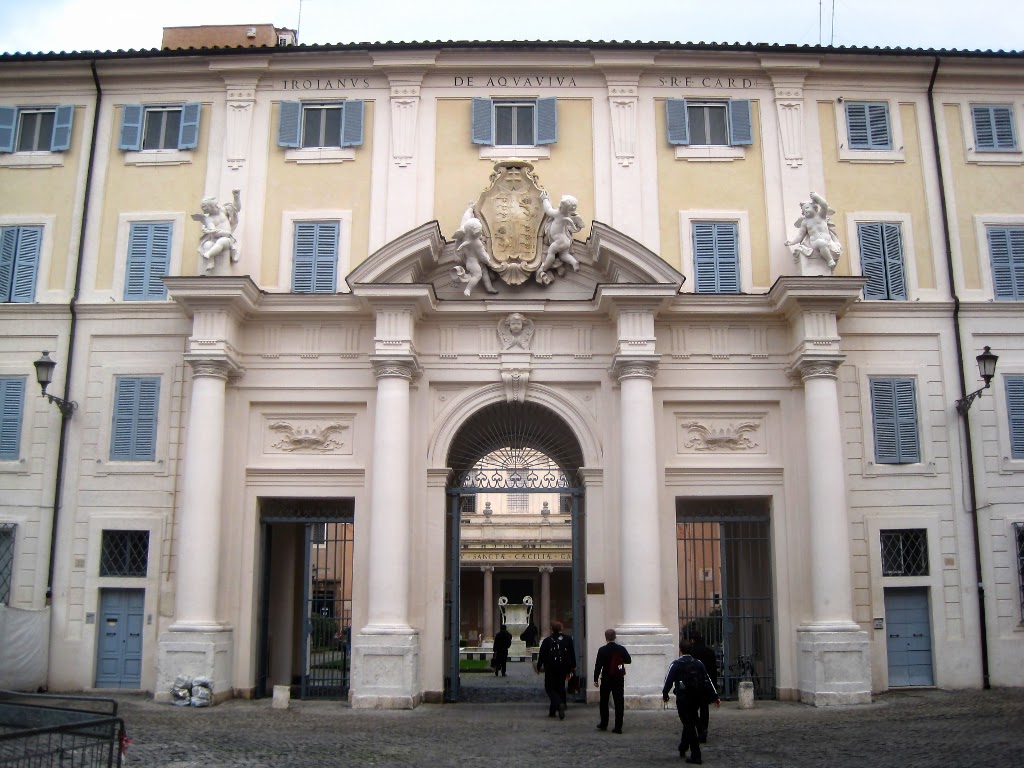
 
 
You enter the courtyard of Santa Cecilia through this archway, built in 1724 by Ferdinando Fuga.


In the latter half of the 300s, the first shrine to this saint was built on St. Cecilia's home.  Pope St. Paschal I (+824) replaced it with a proper basilica, at which time her remains and those of her companions were moved here from the catacombs of St. Callistus.  She is buried with Ss. Valerian, Tibertius, and the Popes Ss. Urban I and Lucius I.

When you enter the church and move directly to the right, you come to the Chapel of the Caldarium, which is built over the bath of the house of St. Cecilia where the Romans tried to suffocate her.  Per usual, many centuries of renovations give the church its present appearance.  Some items of note: the mosaic in the apse (sorry it looks really green) is from the ninth century.  The campanile outside and exterior porch were built a little further on in medieval times.  Also from this time is the tall Gothic covering thing over the high altar.  It's called a ciborium or a baldacchino (it's quite beautiful up close), and it was completed in 1293 by Arnolfo de Cambio, who also did the ciborium for St. Paul Outside the Walls.

But the real artistic treasure of this church is beneath the altar.  It is a marble statue of St. Cecilia sculpted by the artist Stefano Maderno right around the year 1600.


Stefano was present when St. Cecilia's tomb was last opened in 1599.  Amazingly, she was found to be in an incorrupt state, and the following year Stefano sculpted this statue which depicts the position of Cecilia's body in death.  You can see the gash wound on her neck, but despite the violence done her, she still appears to sleep peacefully.  Always a great reminder of the final resurrection which awaits all of us, so thank God for Lent when we can work a little harder at getting ready for that day.

Tuesday, March 18, 2014

Tuesday of Second Week: Santa Balbina

Today we take another walk down past the Circus Maximus to a little church on the side of the Aventine hill, near the ancient Roman baths of Caracalla.  It is named after the daughter of Quirinus, a tribune of the Roman army in the early second century.  Her statue is among the 140 saints that line the top of St. Peter's colonnade.

Balbina and her father converted to Christianity after Pope Alexander I prayed for a miraculous cure from illness on her behalf.  The cure came after she followed Alexander's directive to find and kiss with devotion the chains of St. Peter.  Balbina and Quirinus were both martyred later on for their conversions; one account puts their martyrdom together in 116 under Trajan, others put hers much later in 130 by Emperor Hadrian.

Santa Balbina

This church is located over the home of Lucius Felix Cilonus, a wealthy Roman of the early fourth century.  His residential complex came into Christian hands and the large hall on his property was converted into a church.  Its wall were raised in 370 to give it the basic shape it still has today.


The layout has remained quite simple and austere, as it was from the beginning.  Its apse was rebuilt in the medieval period, and the exterior porch was added in the late sixteenth century.  The baroque fresco in the apse depicts St. Balbina (bottom center, I believe) in the glory of heaven, whose relics, by the way, are held in the marble casket underneath the main altar.  The other cool thing in this church is in the fourth side-chapel on the right, which contains an image of the Crucifixion.  This image was saved during the demolition of the original St. Peter's basilica (built by the Emperor Constantine) and brought here.

On an unrelated note, I put together a map of the station churches in Rome we've visited thus far.  I'll be updating it and reposting it every week or two so you can follow the progress.  You can take a look below.  Today's church is the southern-most marker on the map -- a nice little walk!

- The light blue markers are the churches we've seen in these blog posts.
- The orange markers are the Saturday / Sunday station churches.
- The gray lines are my walking paths from the College to the day's station.
- The orange line is the approximate layout of the ancient Aurelian walls of Rome, for perspective.
- The black line is approximately 1 km, also for perspective.


Monday, March 17, 2014

Monday of Second Week: San Clemente

Happy St. Patrick's Day everyone!  It's fitting that today we visit this particular station church, because its caretakers are the Irish Dominicans.

So during the 40 days of Lent, the priest always wears purple vestments.  I was hoping that we might just be able to substitute them for green vestments in honor of everyone being Irish today.  But alas, no such luck!  If only St. Patrick's Day were on April 1...

On the other hand, today's station church is one of my favorites in the whole city of Rome!  Actually it tends to be on many people's short lists, given its history and its interior beauty.  Amidst the several hundred churches you will find in Rome, this would be one of those particularly worth seeing. 
 
Basilica of San Clemente

Saint Clement's basilica has a long-standing history.  It is named after Saint Clement of Rome, the fourth pope (92 - 99 AD) who was martyred by order of Emperor Trajan.  He was first banished to present-day Crimea, Ukraine for converting over 400 Romans of official rank.  So Clement merely continued his evangelization work in exile, converting the locals and shooting fire from his fingertips.  For this Trajan sentenced Clement to death and he was thrown into the sea with an anchor around his neck.  Perhaps the Black Sea?  I'm not sure, but that's why in Christian art you often see St. Clement posing with an anchor.

In the following years, a major recession of the tide and a lowering of the water table level allowed his relics with the anchor to be recovered and buried nearby, where they would be later found by St. Cyril in 867.  This is the Cyril we talked about earlier, the one who made the Cyrillic alphabet and converted the Slavic people to Christianity.  Cyril returned these relics to Rome, where they were laid in this basilica next to St. Ignatius of Antioch under the high altar by Pope Adrian II (Ignatius was martyred 107 AD by being fed to wild beasts...how nice).  He (Cyril) died two years later in 869 and his own relics were enshrined in St. Clement's basilica as well.


The church on this site actually began as a 'home' church in the 3rd century because Christianity was still illegal at that point (the home itself was built in the 1st century).  About 100 years later in 390, after Christianity has been legalized, an official basilica was built over the house, which was later renovated in 533-35.  The stone half-walled-in thing you see on the central floor area in the second picture (called a schola cantorum), all that part comes from the sixth century renovation and has survived to today.  We know this because you can find on it the monogram of its donor, Pope John II (reigned 533-35).

The 390 basilica was sacked and ruined by the Norman invasion of 1084 (though not everything was lost, like the schola cantorum), and so the rubble was spread out over the floor and a new church built on top of it.  That's the church you see today, which was rededicated upon its completion in May of 1128.  The beautiful gold-looking mosaic apse you see is from the 12th century; the fresco of the Apostles below it and other frescoes were added in the 15th century, and further renovations would happen in the 18th century, including the coffered ceiling you see in the second photo.  So this church is Exhibit A of 1400 years of church art and architecture.

Excavations of the foundations and crypt were started in 1857 and much of the history of this basilica was rediscovered.  Today you can walk down into the 4th century basilica, and then walk down again into the 1st century Roman house.  Which, by the way, certainly gives all-new meaning to the term 'underground church'.  Lol.  On that note, a corny joke is the best way to end a blog post.  See you tomorrow!

Sunday, March 16, 2014

Friday of First Week: Santi Dodici Apostoli, Part II

I'm back!  What a great weekend.  For those who missed the previous post, I headed out of Rome Friday afternoon for a town a bit north called Spoleto to chill out with my classmates on our yearly 'class travel weekend'.  About 60 of us altogether.  As it turns out, the drive was a bit longer than Google maps told me it would be (and I thought Google knew everything?).  But that was perfectly fine since it meant more zzz's on the bus.  This all made me thankful for spending my childhood driving to Florida every year to visit Grandma and Grandpa: you get real' good at learning to nap whilst sitting up.

At any rate, I knew I wouldn't have time to finish a post about Friday's station church, so I promised to post it today instead.  Therefore here it is!

Santi Dodici Apostoli

The nice thing about Italian is that it often uses cognates, if not with English then at least with Latin, so you may have already guessed that Friday's station was the basilica of the Holy Twelve Apostles.  This one is RIGHT next to the Gregorian where I go to school.  Another gem of the city, it has a bit of an interesting history (lol, just like every other church we've come across so far).


The earliest record of a church dedicated to the Holy Apostles dates from the time of Julius I in the mid-fourth century, built down by Trajan's Forum.  Apparently it didn't last long, because Pope Pelagius I built version 2.0 on the current site of this church in the mid 500s; it was finished and dedicated by Pope John III in 570.  At this time, the relics of the apostles Saint Philip and James the Lesser were placed underneath the main altar.  It lived in peace until 1348 when a massive earthquake damaged it significantly.  Pope Martin I in 1421 started a reconstruction and restoration, and then again Sixtus IV during 1471-84.  This church was given over to the care of the Franciscan order in 1463, and they still staff it to this day.  They did lots more things and stuff re: new construction in the early 1700s, a new facade in 1827, and a new confessio (a sort of crypt underneath the main altar) in 1871-79.  That basically takes us to what we see today when we walk in and see it in person.

But let's talk a bit about the history of this church's entourage.  500 years back, during the Italian Renaissance, the Colonna family lived next door to this church, one of the most powerful in Rome.  They were quite famous for their lavish parties with fountains of wine and gleaming gold and silver decorations.  The spacious piazza in front of this church and the family mansion (Piazza Santi Apostoli) made for good times and large crowds.  So they used to do some other interesting stuff to entertain themselves, like throw barnyard fowl from the Colonna palace loggia (loggia is a central upper-story balcony) onto the crowd in the piazza below.  The piazza was also famous in this time as the place of all the best street fights between battling factions of the city struggling for power.

Centuries later in the early eighteenth century, the Stuart family -- the last Catholic royal family of Great Britain -- lived in exile in Rome right next to Santi Apostoli after a failed attempt to retake the throne.  King James III took up residence at the Palazzo Muti for 40 years, where his son Charles III would be born.  He would pray in this basilica every day and at his death he was laid here in state, afterward being buried in Saint Peter's!

Besides Ss. James and Philip, we find lots of martyrs buried here: Ss. Sabinus and Clement; Ss. Eugenia and Claudia and companions; and Ss. Diodorus, Marcian, Chrysanthius, and Daria.  Always a beautiful testimony that reminds us our home is not here, and it's worth giving everything to receive the kingdom which is not of this world.

Friday, March 14, 2014

Friday of First Week: Santi Dodici Apostoli

Hey, we made it!  We're at the end of the first full week of Lent.  Phew!  This weekend I'm heading out of town with my 60 classmates to the little town of Spoleto, about a 90-minute drive north of Rome.  It's our fraternity weekend, which means I'm taking zero homework along.  I'll be sleeping in, listening to some good tunes, taking a walk or three around town and enjoying the company of brotherhood.  It shall be, as they say, good times!

But the thing is, we're leaving right now.  Ain't nobody got time for nothin' more.  So I shall be finishing this post when I return on Sunday.

Peace!

Thursday, March 13, 2014

Thursday of First Week: San Lorenzo in Panisperna

Today's church is in the exact same direction as St. Mary Major, except about a block closer to the College.  No worries, though, that's still a fair 40 minute walk!  Although we do a bit of a speed walk in the mornings (no use entering a station church during Lent without perspiration) so we got there in about 34 minutes.  I only know because I checked my watch at departure and arrival.

This little guy is just a small chapel compared to yesterday's church.  In fact, we didn't even all fit in it for Mass!  Half of us were standing along the aisles and in the back, and about 20 guys were standing outside the front entrance.

San Lorenzo in Panisperna

This church is named after the deacon St. Lawrence who was martyred on this very spot on the 10th of August in 258 AD under Emperor Valerian.  I believe I may have told this story before, but it's good to recall it again.  Lawrence was given administration of the Church after the arrest of Pope Sixtus II and four of his fellow deacons in the Catacombs of Callixtus on the 6th of August.  He met the pope as the group of five were being led to prison and execution, begging to be able to accompany him.  The pope declined, giving Lawrence charge of the Church's temporal goods while telling the deacon that he would follow his bishop in four days' time.

So Lawrence went forth and distributed all the material goods of the Church to the poor of Rome, and himself was soon arrested for being Christian.  Brought before the magistrates who demanded that he hand over the Church's treasure, he went and gathered the poor of the city and presented them to the Roman officials, saying that they were the true treasures of the Church.  Well you can imagine how that went down!

The magistrates were enraged and threw him in a dark prison cell nearby, whereby he proceeded to convert the jailer and his family to Christianity.  In utter frustration they demanded that Lawrence be burnt alive over a gridiron, which was subsequently set up on the site of today's station.  So on the 10th of August, as his bishop had prophesied, the deacon Lawrence was martyred, burnt alive for his steadfast faith in Christ.  But not to be outwitted even til the end, his final remarks to his executioners were the words, "Turn me over, I'm done on this side."


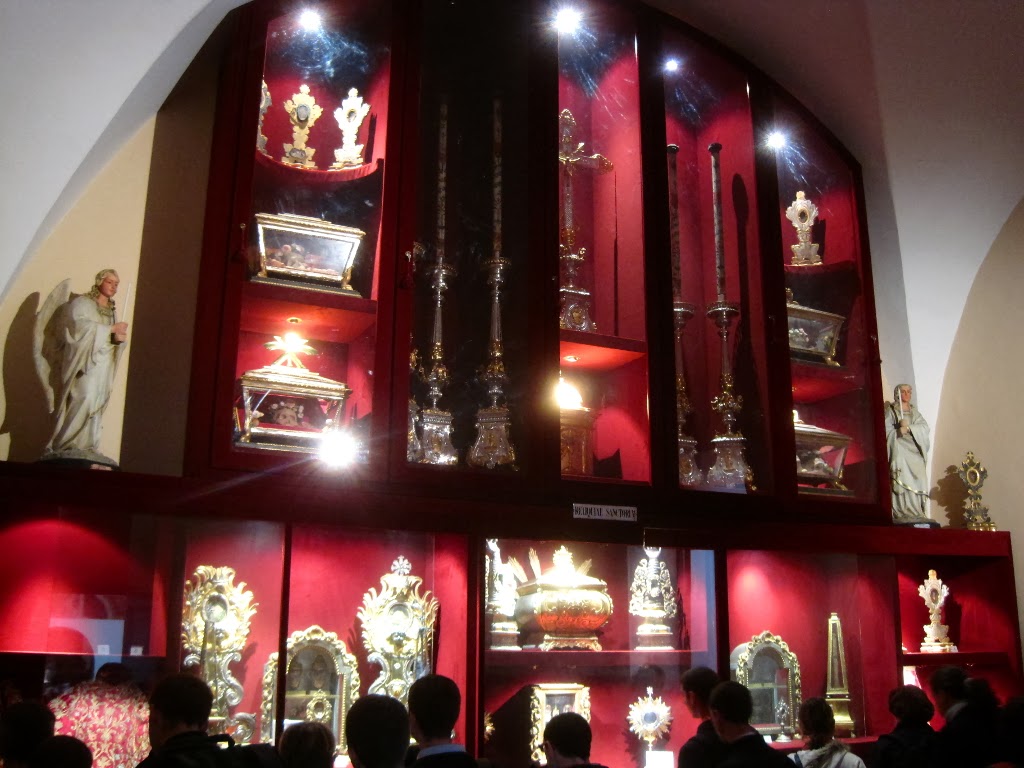
Ok I broke my rule again.  But I had to!  This is a reliquary room located behind the sacristy of the church with a whole wall full of the bones of saints.  You can see a few skulls above.
 
 
Records of a church on this site exist from at least the late 800s, then called St. Lawrence in Formonso, so-called because of its association with Pope Formosus, who led the Church from 891 - 896 AD.  The current church was built to replace the original one in the period 1565-74, and a restoration in 1757 gave the church the appearance it has today.

One neat thing, the fresco behind the main altar which you see above is the second largest in Rome, behind only the Final Judgment fresco of Michelangelo in the Sistine Chapel.  It is the scene of Lawrence's martyrdom on the gridiron while the emperor looks on.  Also in this church is the original sarcophagus of St. Brigid of Sweden and the relics of the brothers, Ss. Crispin and Crispinian (martyred 285 AD under Diocletian).  You may recognize their names from Shakespeare's Henry V, where the famous 'St. Crispin's Day' speech ("...We few, we happy few, we band of brothers...") was given on their feast, the 25th of October.