Wednesday, March 12, 2014

Wednesday of First Week: Santa Maria Maggiore

Today we encountered one of the most prominent churches in Rome, the Basilica of St. Mary Major.  This is a beautiful and impressive church, and is one of the four 'major' basilicas, the highest-ranking churches in all of Christianity (together with St. John Lateran, St. Paul Outside the Walls, and St. Peter).  All other churches which are named basilicas are called 'minor'.

This term (major basilica) was first used by Pope Boniface VIII in the year 1300 in reference to the churches of St. Peter and St. Paul Outside the Walls, where these two greatest of apostles are buried.  Pope Clement VI in 1350 added St. John Lateran to list, since it is the first and oldest church in all of Christianity, and in 1390 St. Mary Major was also named to round out the list.  St. Mary is the oldest Christian church dedicated to the Blessed Virgin.

Basilica of St. Mary Major

The construction of this church began in 352 by Pope Liberius after a miraculous snowfall occurred on the site of the Esquiline Hill (one of the seven original hills of the city of Rome) on the 5th of August.  After the Council of Ephesus in 431, where Mary was officially recognized with the title of Mother of God, then-Pope Sixtus III began construction on a second, larger church about one block behind the first one.  It is this second church which has come down to us and which you see in the pictures below.  Relics from Christ's manger were brought from Bethlehem in the 7th century and enshrined in this church, at which time it took on the name St. Mary Major.


Sunrise!  Sorry, I couldn't fit it all in one shot so I stitched a few together.  The perspective is somewhat skewed.


I decided I was allowed to post three pictures today because this is such an important church.  It goes without saying that they don't do the real thing justice, you gotta see this thing in person!

In 1295 the rear wall and apse were demolished and a transept and new apse were built.  New side chapels were constructed for this church in the thirteenth, fifteenth, sixteenth, and seventeenth centuries.  The campanile, which is the tallest in Rome, was built in the late 1300s, and Pope Alexander VI and St. Charles Borromeo were pastors of this church in their day (for a basilica, the term is technically not 'pastor' but 'archpriest').  One other interesting note, some may know that Ss. Cyril and Methodius (lived in the mid 800s) are well-known for their missionary work and the conversion of the Slavic people to Christianity.  As part of their mission, they created the Cyrillic alphabet and translated the Scriptures into a new Slavonic language.  It was in this very church that Pope Hadrian II approved Ss. Cyril and Methodius' translation of the liturgy into Slavonic for use on their missionary journeys.

I'm tuckered out and will stop writing here, although there is tons more to say about St. Mary Major.  I'll have to save it for next time!  On to bed and to our next church tomorrow.  Keep praying for me!

Tuesday, March 11, 2014

Tuesday of First Week: Sant' Anastasia

Good news, we made it to our church today and the doors were even open and welcoming!  Woohoo!  It's good to be back on track.  Had some blah-looking clouds in the sky this morning, but thanks be to God no rain.  I'd like to keep that streak alive as long as possible.  Today's station church has probably been my favorite church yet.  Just beautiful on the inside.  Reeally wanted to take more pictures, but I am keeping myself to a strict 2-3 shot regime, else things will quickly go haywire and I won't have time to choose and post every interesting detail.

Sant' Anastasia

This church sits right next to the Circus Maximus and, like the other ones we have visited, was constructed very early on.  The spot of this church used to be a district of Roman houses and shops which were demolished in order to build a small Greek-cross-shape chapel (like a plus sign, a cross with equal length sides) at the request of Pope St. Damasus in the late fourth century.  It was re-dedicated to St. Anastasia about a century later when veneration of her life and martyrdom spread to Rome from Constantinople.  Anastasia did not live or die in this city but was martyred in Sirmium, located in modern-day Serbia.

An interesting note, St. Anastasia's feast day is December 25, which is why in the back apse of this church there is an image of the Nativity.  It's also why you probably never remember celebrating her feast day at church, because you were always celebrating Christmas instead!


There is a tradition that when St. Jerome would stay in Rome, he would say Mass at the chapel that stood here (+420 AD, Jerome is super important; he translated the Hebrew OT and Greek NT into Latin, which we still use today).  Right around 500 AD, the nave was extended so that the church's dimensions approximated those of today, which you see in the photo.  Refurbishments and additions occurred subsequently in the ninth century (Pope Leo III), thirteenth century (Innocent III), and fifteenth century (Sixtus IV).  The 1500-1700s saw the addition of some side chapels and the current facade (1634-40), as well as its most recent renovation (1721-22) which gave it the appearance it has today.

This church is worth checking out if you ever visit Rome, especially for the stunning marble statue of Anastasia sleeping in death underneath the high altar.  The ceiling above the altar contains an inscription appropriate for a church located so close to the circus where Christians were routinely executed:

They fought with the Lamb, that the Lamb would conquer.

The Circus Maximus and the empire that built it have long since been buried.  This church still stands.

Monday, March 10, 2014

Monday of First Week: San Pietro in Vincoli

Well here we are.. it's the start of the first week of Lent.  And our first stop this week took us all the way across town to San Pietro in Vincoli.  In English that would be, Saint Peter in Chains -- so called because this church contains the the chains that bound St. Peter during his imprisonment in Jerusalem (Acts, chp. 12).  Neato!

San Pietro in Vincoli

Perhaps the best way to describe this church is to begin with the photo op:


What you see here is the full extent of this morning's experience with this church.  This photo was taken at about 6:40ish a.m. when I arrived; duly note all those patiently waiting for the gates to be unlocked (this is about a 20% of everyone that showed up).

Well you see, what happened was that the folks who were supposed to open this station church for us this morning were not in fact present to open it.  We all stuck around until about 7:10 and then couldn't wait any longer (people had class and other schedules to keep), so many of us walked back to the Casa Santa Maria (the graduate house for student priests of the NAC, located in the middle of Rome, right next to where I go to school at the Gregorian) and we had Mass there instead.

I was thinking to myself, yes there is just one day in the whole year when this church needs to be open.  But then I remembered, no this is all just part of the experience.  Whoever it was that forgot to be there has officially received the All-Italia Award.  Only in Italy..  lol!  Sorry I don't have much more than this for you today, folks.  I'm going to bed and we'll try again tomorrow.

I'll leave you with two of today's spiritual lessons that God was looking to teach me.. 1) Be merciful.  We all biff it pretty bad sometimes in life, God needs me to take things in perspective and give others a break.  We're all fighting our own battles.  2) Sometimes in life, my best laid plans go awry.  And then life goes on.  Let me always be thankful that God walks with me through every unexpected change.

Friday, March 7, 2014

Friday after Ash Wednesday: Santi Giovanni e Paolo

It was another crisp walk to our station church this morning with mostly clear skies, so we walked in the twilight while the undersides of the scattered clouds slowly turned red, then yellow.  We also continued to stay on the south side of the city and east of the Tiber, except a bit further today, so about a 40 minute jaunt.  We strolled silently past the ancient Circus Maximus on our way and crossed the street a little further on to make our way to this beautiful church.

Santi Giovanni e Paolo

The basilica of Saints John and Paul (the John and Paul who we name when we pray Eucharistic Prayer I in the Mass) was a wonderful place to have our Friday morning Mass; it is the biggest church we have been into yet (though by no means a 'big' church in this city).  This one was originally built in the late 300s and early 400s through the generosity of a Roman senator, later saint, named Pammachius.  He built it over the former house of the two patrons who were martyred on that spot in the mid 4th century.

John and Paul were Christian Roman soldiers who were chosen to serve as functionaries in the Imperial household.  For a time they were able to hold to the orthodox Christian faith despite the emperor often falling into heresy.  Alas, this changed with the ascension to the throne of Julian the Apostate in 360 (who was not only a heretic, but as his title demonstrates, an apostate as well).  Julian declared that those who did not follow his pagan religion would be declared traitors to the empire and executed.  John and Paul refused to cooperate, so were put to death in their home and buried nearby.  Execution of Roman citizens like this within the city walls was actually an illegal thing for the emperor to do, but it seems that Julian wanted to be as discreet as possible about this bounty because of the unpopularity of his command that Christians apostatize (meaning, that they publicly renounce their faith).

The basilica was heavily damaged in 1084 by a Norman army that laid siege to the city of Rome and was largely repaired in the following century.  It went through more restorations through the centuries, but the most striking (or at least the most interesting) is the one carried out in 1948-50 by Francis Cardinal Spellman (+1967) of New York.  This basilica was his titular church in Rome; he restored the facade to its medieval appearance and added a series of chandeliers to the interior which were taken from the Waldorf-Astoria hotel in New York.


It was hard to get a good picture in here with the low lighting.
 
 
A couple cool little things.  In the bottom picture on the right side of the aisle you'll see some red candles on the floor of a small gated square.  It was directly underneath this spot where Ss. John and Paul were martyred.  The foundations of this church have been excavated so that it is possible to see some of the remains of the home where John and Paul were posted.

The church is run by the Passionists, a religious order whose founder, St. Paul of the Cross (+1775), is buried under the main altar in front.  I was pleasantly surprised to discover that if you enter the basilica and turn immediately left, the first side chapel you'll come to is dedicated to one of the saints in my personal arsenal, St. Gemma Galgani (+1903).

Thursday, March 6, 2014

Thursday after Ash Wednesday: San Giorgio

Well today we have reached a new milestone..  We can now begin speaking about blog posts "in a row".  Small victories are victories nonetheless!  Thanks for the prayers.  So today was perhaps a bit more tiring to wake up, but what I really can't wait for is when we hit the approximately three week, four day mark.  I'm sure I'll be feeling like a million bucks as soon as I throw my alarm clock at the wall.  But in the meantime, onward we march!

San Giorgio

San Giorgio is in the same general direction as Santa Sabina, but not quite as far -- about a 30-35 minute walk from the College.  It is on the south side of the city just east of the Tiber.  I'm gonna have to get a map up and start marking these things for you so you have a better idea.

The full name of the church is St. George in the Velabrum.  Back in the day this part of Rome was called the Velabrum for all the yellow sand that seemed to be gathered there (from the Etruscan word velum for 'marsh', and the Latin word aurum, 'gold').  It was nearby the cattle market of ancient Rome (the Forum Boarium).  St. George himself was a late 3rd century Roman soldier and martyr who was tortured and decapitated at the decree of then-Emperor Diocletian for being a Christian and refusing to make a sacrifice to the Roman gods.  He is the patron saint of at least eighteen countries and is one of the most prominent patrons of soldiers.  His traditional sign is the red cross on a white background.  The central red cross on the flag of the United Kingdom is the Cross of St. George.

Actually, this church used to be named after both Ss. George and Sebastian, particularly because of its location nearby the Cloaca Maxima (ancient city sewer--which, by the way, still functions today) into which Sebastian's body was thrown after his martyrdom.  The first Christian building on this site was not a church but a deaconry; it was built in the late 5th century and served as a distribution center with supplies for Rome's poor and needy, although the site did include a small chapel.  Pope Leo II undertook a major restoration of this building in 682-683 and dedicated it to Ss. Sebastian and George.  A relic of St. George's skull was placed in this church by Pope Zachary in the early 740s and has been there since--today you can see it behind a piece of glass under the main altar.

So what's the deal with relics anyway?  Catholics seem to love displaying body parts of saints or important Christian objects (the manger, the true Cross, the nails, the crown of thorns etc.) in glass cases under the altar or in little niches of our churches all over the world.  Are we super wacko?  Well every family has some of those!  But there are a few things going on here worth mentioning, I suppose.

Seeing the dead reminds us that one day we're going to die, and that's prolly a good enough reason in itself.  The 'Last Things' are so important to think about!  (If you've never really done this before, a great way to start is by pondering, praying about, and imagining every day what heaven must be like.)  Mortality makes us realize how important the important questions are: what does life mean, how should I live it, where am I going and what happens when I die, does it all matter, can I hope in something that lasts, why is death and suffering so hard?

Seeing the bodies of the saints also helps us take courage from those who have gone before us and have "won the imperishable crown", "fought the good fight, finished the race, and kept the faith".  Since we are 'enfleshed' souls, our bodies themselves are sacred -- in fact St. Paul calls our bodies temples of the Holy Spirit!  And so we honor and give our respect to the body even after the soul has left it.  And a big reason Catholics love relics is that as Christians these relics remind us of our belief in the final bodily resurrection.  We're going to get these babies back in perfected form, friends!  So as good stewards we keep them with care while the body sleeps in death until the final and definitive coming of Jesus.


So now back to our church!  The exterior porch and campanile (bell tower) of this church which we see today were rebuilt in the 13th century from an original addition during the medieval period.  Inside, above the apse you can see a fresco with the figure of Christ flanked by the Blessed Virgin Mary, St. Peter, St. Sebastian and St. George (on a white horse).

One last interesting note is that this church used to be the titular church of Blessed John Cardinal Henry Newman (+1890) and Otto Colonna (+1431), the man who became Pope Martin V.  Sweet!

Wednesday, March 5, 2014

It's Ash Wednesday, People, so Here We Go.

Aaannd we're back!  (Again.)  Hey, happy Ash Wednesday and happy Lent everyone!  Long time no see!  By the way, go and get your ashes today.  What have I been up to the last six months?  Oh man, tons of stuff.  Tons.  Thousands of pics galore and too much to put down here in this post.  But in anticipation of the glorious Resurrection which is moving fast upon us, it is time to resurrect this blog and start again.

Well actually, the good motivation for this has been in the works for some time now.  But what has pushed it over the edge is a special little something that starts to happen in Rome about this time of year.  Cue down the house lights and bring up the spots.

So, every year during the liturgical season of Lent (the 40 days before Holy Week, which culminates on Easter Sunday) there is a loong long standing tradition in Rome called the Station Churches.  What are the Station Churches and where do they come from?

The roots of this tradition go as far back as the late second / early third century in Rome.  The bishop of Rome (the pope) would celebrate different liturgies of the liturgical year at various churches throughout the city (at that time, churches were still 'underground') as a way to unify the Christian community, particularly in the midst of sometimes bloody Roman persecution.  After Christianity became legal in 313 AD with the Edict of Milan, these 'stational' liturgies by the pope became much more public and began to take on a more formalized structure.  St. Lawrence's feast day at the church where he was buried, St. Paul's feast day at the church where he was buried, Christmas at St. Mary Major which holds a relic of Jesus' manger, etc...  Well the Lenten station churches in particular have stood the test of time, and so even today 17 centuries later this yearly tradition continues.

Every day during Lent, the Christian community celebrates the Mass at a designated station church somewhere in the city of Rome.  For the past several years the North American College has been participating in this tradition: many of us (it's optional) walk en masse from the College to the day's church (sometimes near, sometimes on the other side of the city! sometimes in the cold or rain) in time to celebrate a 6:45am Mass for ourselves and whoever else shows up.  It means sacrificing a little bit of sleep each day to get up earlier and make the walk, but you have to take advantage of these things while you still can!

So anyway, I have decided this year that as part of my Lenten practices of prayer, penance, and almsgiving, I will be participating in all the weekday station church liturgies.  Prayer because.. well that's obvious.  Penance because getting up earlier is a huge penance for me.  And almsgiving because I will be daily posting on this blog a picture or two and a short description of all the station churches I attend.  How's that for creativity!

Good, now part of your Lenten practice of prayer will be to ask for the grace that I make my daily post.  Seriously!  I'm serious, give me.. approximately one Hail Mary a day.  For Pete's sake I'm clearly not able to blog with consistency, so let's help me out.

Today is Ash Wednesday, the first of 40 days of Lent, so let us begin yonder Roman Station Church journey.  Most of my commentaries on these churches will come from a little book with a Latin title called Procedamus in Pace which the NAC has put together.  All informational credit is due this book and the seminarians / priests who put it together.

Ash Wednesday: Santa Sabina
 

Walking in.  Extra chairs are outside because Pope Francis is going to celebrate Mass here later on today.


Santa Sabina is located on the Aventine Hill, one of the seven original hills of Rome.  It was originally built during the last days of the Roman Empire, and is believed to be located near the house of the Roman matron St. Sabina, a widow who was converted to the Christian faith by her slave, Seraphia.  Around 126 AD they were both condemned to death and executed for being Christians.

The current church was built by the priest Peter the Illyrian during the papacy of Celestine I (422-432) and has undergone major restorations several times through the centuries (820s, 1560s, 1910s).  Santa Sabina was given over to the Dominicans by pope Honorius III (1216-1227) and it now serves as the mother church and world headquarters for this religious order.

One significant thing about this church are the main doors which are made from cypress and are original to the church (!).  These wooden doors are generally agreed to be about 1600 years old.  The uppermost left panel of the left door contains one of the oldest depictions of the Crucifixion in Christian art.  Whoa!

As it says in my handy book Procedamus, one of the tombs along the right aisle has an inscription which is appropriate for the beginning of our Lenten journey:

Ut moriens viveret, vixit ut moriturus
That dying he would live, he lived as one who was to die

Thursday, August 22, 2013

Those Lingering Missing Links


A small update before getting started.  The infamous European-Summer-Palooza has been flying by (per usual) and I am currently finishing up my pastoral assignment in Cagliari, Sardinia.  At this point I am fairly convinced that the world is saved from premature extinction despite the man's best efforts only because there are still those faithful souls (we have the feisty little old Italian ladies here) who sit in the local parish all day and pray the rosary in front of the Blessed Sacrament.  It is a theme I have been learning a lot about over the past year, that God seems to enjoy accomplishing the extraordinary in the most ordinary of ways.  Hmmm, perhaps that will be a homily theme one day!

In this post I will divulge everything in my first year of semi-expatriation which has not yet been put up.  All the missing links, as they say.  These are the wonderful experiences that God's generosity has provided through the generosity of many good people who know me, pray for me, and sacrifice for me.  It's about time all that goodness be shared back!  After all.  Our beloved St. Thomas Aquinas reminds us in his Summa Theologiae that goodness, of its own nature, diffuses itself.  Therefore, please do the kind favor of enjoying the following self-diffusion of the good things that God and good people have made possible in a young man's life.

Please let me specifically thank the fabulous Knights of Columbus councils who --- among many other worthy endeavors --- offer themselves to the Church as a significant rank of invisible soldiers for Her priests and priests-to-be.  Including this dude.  So when you think of it, do say a prayer of thanksgiving for them =).

Back to the beginning it is, then!  Yes, here we are.

1ST YEAR RETREAT

This happened after I returned from my first month in Assisi and before beginning the official start of academic theological studies.  We were back in Rome for another month-ish of Italian lessons at the NAC, but took a week off to attend our annual canonical retreat.  It was outside of a little town called Greccio, north of Rome, and included both beautiful vistas for day dreaming and mountainous landscapes for exploring.


This is a night view looking out my bedroom window.  I just thought it looked neat, so I took a long-shutter snapshot.

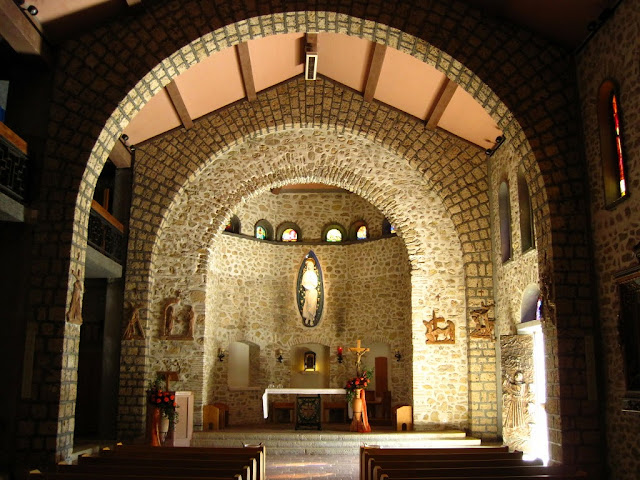
I really enjoyed the chapel next to the retreat house.  It was simple, of arched and sturdy stone, and was very tranquil.  Did more than one holy hour in here for sure!

I've never seen a Marian statue like that before.  I thought it was beautiful.

Another long-shutter snapshot looking out into the valley.


We always take our retreats before the beginning of the school year.  They are one-week silent retreats, so there is zero talking (except liturgical responses), even during meals, and no watching TV, no computer, no cell phone, no Internet, no iPad, iPod, YouTube, WeThis, or TheyThat.  We are totally unplugged!  It is a time to be silent and give over the year to God, to listen to him and be alone with him.  Yet it is no nightmare having zero access to the outside world.  In fact, I compare that feeling to the scene at the end of Free Willy when the Orca finally jumps over the rock wall in slow motion.  Except now also add the Braveheart version of Mel Gibson yelling "Freeeeeedoomm!!!!!".

All things considered, it was a wonderful retreat.  I had been out of the States for just over two months at that point, and not only needed some real down time for reflection, but some real down time for rest and recuperation.  In fact, if I remember correctly, in the first three days I slept about 34 hours altogether.  It was a good lesson which has been continuously repeated throughout this interesting Roman adventure.  St. Paul says it well.  He speaks in several of his letters about the analogy of running and winning the race which leads to eternal life.  It is the Christian life of faith, and for many, it is no dash but a marathon (or several!).

Enter stage left, my learning curve.  One of the demands of prudence, it turns out, is a proper share of zealousness for times of rest and time away with Jesus.  Otherwise one slowly becomes a not-so-zealous worker in his vineyard.  We cannot give what we do not have, and thus we can't pretend that we can give Christ to others if we don't first receive him.  So it is necessary to take dedicated time each day to go away and be with him.  Periodically, this includes taking longer amounts of time to rest and refill the spiritual and physical gas tank.  Such a program makes us like the wise virgin or the master builder who prepare and work in measured fashion, in order that we may be able, like Christ, to do all things well (cf. Mk 7:37).

AREZZO

This nice little Tuscan town was a place I visited with two of my classmates last October.  It has some pretty deep roots.  It was established by the ancient Etruscan peoples and was later taken over by the Romans in the 4th century BC.  There are several historical and religious gems in this city if one knows where to look.  And on a side note, I just recently learned that one of its sister cities is Mount Pleasant, MI.  Imagine that!

The weekend we were there must have corresponded to some malfunction in the heavenly floodgates, because it sure did rain much more than any rational Joe would consider 'a fair share'.  But bad weather aside, Chris, Garrett, and I enjoyed some good time with the town's local seminarians (we stayed at their seminary) and made sure that we sampled some of the local Tuscan wine.  No complaints here!


Arezzo is the birthplace of one of music's most helpful men, the legendary Guido Monaco.  Who is this mysterious character, you ask?  Guido was a Benedictine monk who lived at the beginning of the 11th century.  He is the one who invented modern musical staff notation, which would replace the neumatic notation of Gregorian chant to become the standard way of dictating music on paper.  The  Do - Re - Mi - Fa - So - La - Ti - Do moniker we all know comes from Guido (whose original musical model was Ut - Re - Mi - Fa - Sol - La). 

This is the cathedral of Arezzo.  Beautiful and Gothic on the inside, although I didn't capture many good pictures of it because unfortunately it was not lit very well at the time.

Arezzo in the evening.  That tower on the left up there is the bell tower of Santa Maria della Pieve.

This is the main square of the city.  Famous for its role as a backdrop of the film "La vita é bella", a very popular Italian drama comedy which won several Academy Awards in 1997.  The movie cost $20 million to produce and grossed $230 million worldwide at the box office.  Holy cow, Batman!  What do you even do with that kind of money?!


That sign says, "Here was born and lived GUIDO MONACO".

This made me chuckle.  Well played, young Clever-Road-Sign-Sticker-Graffitti Person.

This is the inside of the Church of St. Dominic.  This otherwise fairly nondescript church is famous for that big crucifix up there over the altar.


This sanctuary crucifix was constructed in 1256 by the Florentine painter Bencivieni di Pepo; he is also known more simply as Cimabue (your guess is as good as mine!).  It is a very well-known work of his and is particularly noted for the way it shows the artistic and theological development of the time.  It is most often compared with its progenitor, the Crucifix of San Damiano, now located in the Basilica of Saint Clare in Assisi.  This is the famous crucifix that St. Francis was praying before when he received the call from Jesus to "rebuild my Church".  Take a look:


The Crucifix of San Damiano was constructed in the Byzantine iconographic style right around 1100 (unknown artist).  So this is a century and a half before Cimabue.  Notice the immediate differences.  Jesus is victoriously standing straight up, his eyes open wide, and while it's hard to notice at this resolution, his facial expression is calm, almost warm.  He is consoled by people on all sides, and little angels are collecting the blood that drips from his sacred wounds into chalices.  Intentionally, his body position bisects the crucifix precisely in half, as it leads the eyes vertically (Jesus as mediator between heaven and earth) and visually depicts Christ as the center of all things.  His symmetry and tranquility are symbolic of his divine perfection, which is evident even during the agony of the Cross.

Move forward 150 years, and we have Jesus depicted quite differently.  Now he slouches over to the side, slain with eyes closed and bitter facial expression.  He is bereft of all earthly and heavenly consolation save for the presence of John the beloved disciple and Mary at his left and right, who mourn for him.  Jesus' blood flows freely from his wounds and spills off the crucifix with no one to receive it, as if forgotten and worthless.  The position of Christ's body is meant to display the gravity of this event, when all of creation weighs heavily out of harmony and sags under the weight of the Crucifixion.  Whereas San Damiano's Christ clearly emphasizes the divine, Cimabue's Jesus is very human, the one who understands human suffering.

In fact, this work of Cimabue is one of the first of its kind to make some distinct breaks from the Byzantine style, and it would prove to be a huge turning point in Italian art.  His pupil, the great Giotto di Bondone -- who followed him to became the great father of the Florentine school of art -- would greatly contribute to the beginnings of the Italian Renaissance.

CHRISTMAS

Oh my.  What a shame for me.  It's even well past Christmas-in-July, and I haven't finished putting up these photos yet.  Ah well.  All's well that ends well, so here they are!

SALZBURG

Recall that way back yonder, we left off our Christmas adventure in Florence (which was our first stop after the post-Christmas exodus from Rome).  The time in Florence was fun, to be sure, but a bit rainy.  David, Danielle, and I were looking forward to move on to a more Germanic landscape by the time the sun finally showed its face the morning we packed and walked to the train station.

The train ride north from Florence to Salzburg was straight out of a movie.  It was like Steve Irwin the Crocodile Hunter always used to say: "Aw yeah that's just beyuuuutifulll, just gohhhgeous".  The Apennine landscape began to ever-so-gracefully don increasing layers of shimmering white snow, which was a welcome sight to this lover of white Christmases (I still pity all those whose more tropical childhood was ever-impoverished by lack of snow on such an important day).


Northern Italy.  Winding through the mountains was a sight to behold.  It all just looked so trek-able!

I barely got out my camera in time to snap a quick shot of the Italian - Austrian border.

Welcome to Austria.  Wow was this country beautiful!


We arrived in Salzburg in the evening as the sun was setting.  We didn't have much of an idea where our hotel was, other than that we knew the physical address.  So we stopped to buy a city map at the station and walked the 15 minutes or so from there to the first piece of 'little America' that I had known since leaving the States -- a Holiday Inn hotel.  When we got there, we discovered that it was no ordinary big box hotel, but such a hotel in all its Austro-Germanic glory.  Everything was brand new, the floors were *spotless*, there was an automatic shoe shiner at the entrance, and door handles were cleverly designed contraptions which invoked that certain feeling of sophistication.  The lobby hostesses were dressed in the traditional Bavarian dirndl (the blouse, bodice, skirt, and apron thing) and were very cordial.  When we got to our room, we stuck our card into a reader on the wall which turned on all the lights.  Our entire-wall-window had a set of automatic exterior blinds.  It was certainly the nicest Holiday Inn I've ever been in!


We walked toward the historic downtown area for some food and ended up walking into a kebab place along the way which was a bit of a hole in the wall, but nonetheless with delicious food and EXCELLENT beer.  Now I have had German before, but tasting it local and fresh from the tap was simply exquisite.  David can attest.

The next day we explored a little bit of the historic city center and in the afternoon got on a bus which took us just inside the German border for a tour of the salt mines.  Unfortunately we couldn't take any pictures during the tour, but it was nonetheless quite excellent and informative.  The whole time I was thinking of my dad, because I just knew that this would be precisely the kind of tour we would take if we were young kids on our family vacation.


On our ride to the salt mines, we got a brief glimpse at the Eagle's Nest!  This is one of the most well known hideout fortresses of Adolf Hitler during his tenure of power.

Before beginning the tour we were made to put on this full body suit thing.  Sweet!


Since they routinely have an international crowd, everyone put on headsets and listened to the tour in their own native language.  What a fun tour!  Good enough to be recommendable by me.  Afterward, we stopped by the local village called Berchtesgadener to have a quick look around and enjoy some eats from the food stands before returning to Salzburg for the night.


We meandered through the outdoor Christmas market and did some window shopping.  It was a bit chilly...

... but then we found the hot food and hot drink.  Nom nom nom.  It was delish.

This is the first time I saw a sign for the legendary "lederhosen" of the Germanic people.  Had to take a photo.  Unfortunately for me (actually, it was probably fortunate) authentic lederhosen aren't on the cheap side.  Ah well, I would probably never have worn them anyway.


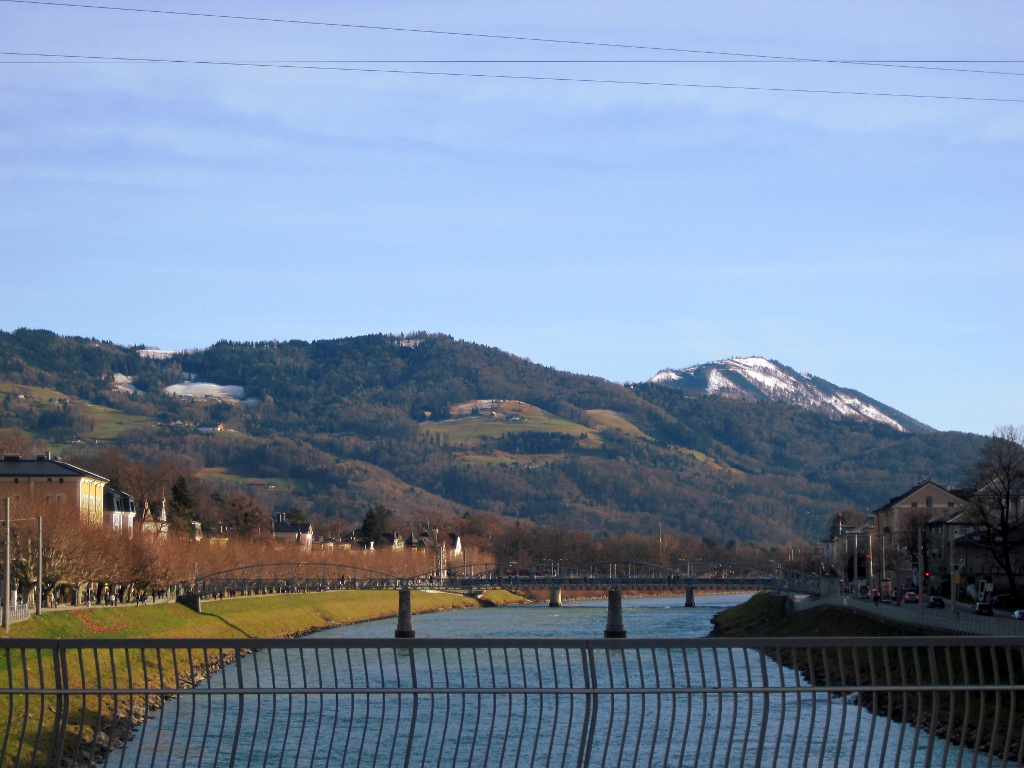
All in all, I absolutely loved loved loved Salzburg.  I would love to go back, and I would highly recommend it to anyone.  It is a welcoming city surrounded by Austrian mountains with a beautiful and clear river running through it, fresh air, friendly locals, and the historic old town has an especially quaint ambiance.  Some neat things to see as well.  There is the birthplace and residence of Mozart, St. Peter's Abbey, the Hohensalzburg Castle, the Salzburg Cathedral and Salzburg Residenz (historical home of the archbishop-princes), the Residenzgalerie (art museum).  Of course, it is also quite famous for its role in the filming of "The Sound of Music", which means there are about 20,000ish tours of the various set locations.  Lots of these things we didn't get a chance to see because we only stayed for two nights.  When we left we decided that it would have been nice to have another full day. 

OK, before stuffing more in, it is time to acquiesce to the eager mouse arrow which is hovering around the "Publish" button.  It appears that when I wrote " *all* the missing links " at the beginning of this post, I must have meant that in an artistic, metaphorical, hyperbolic sense.  I need to push this out now for my own good, so I can feel like I'm making progress!  I'll put up the next set of missing links in the following post.  To be continued!